
Community Feedback Survey Questions: Finding Unmet Needs

Start here: How to Create a Subreddit for Your Business: Find the Gap
TL;DR
- A community feedback survey question set works best when it is built around a specific target audience rather than a general list of people who might have an opinion.
- Questions that mix rating scales with short open-ended prompts give both a measurable score and the reason behind it.
- Clear, single-topic wording improves response quality more than adding extra questions does.
- The best next step is to test a short draft with a small group before sending it to the full community.
- Strong community feedback turns member opinions into specific decisions about programs, products, or priorities.

Community feedback only matters if the questions are built to get a clear, specific answer. A list of ten vague questions produces less useful information than three well-aimed ones. The goal of a community survey is not just to collect opinions, but to find out exactly what a group of people thinks about a specific issue, service, or idea.
Getting this right starts with knowing who is actually answering. A question that works for a neighborhood association will not work the same way for a workplace team or a customer group, because each target audience cares about different things and uses different language. This matters for community engagement survey questions aimed at turning feedback into real action, not just data for a report.
This article breaks down which questions work, why they work, and how to avoid the common mistakes that make survey answers hard to use.
Questions to Ask by Community Goal
Every community feedback survey should start with one clear goal, since that goal decides which questions belong on the page. Community engagement questions work best when they are grouped by purpose, rather than mixed together without a pattern.
Identify Unmet Needs and Priorities
Unmet needs surveys ask residents or members what is missing before any new program gets built. These community survey questions work best as a mix of rating scales and short lists, since they let people rank issues instead of writing long answers.
Useful question formats include:
- Which services do you use most often? A checklist format works well here.
- Which services feel hard to find or access? This points to gaps in outreach, not just gaps in supply.
- Rank these community needs from most to least urgent. A simple 1-to-5 scale keeps this fast to answer.
- What would you add if you could create one new program? This can be followed up with an open text box.
This group of questions gives organizers a clear list of what to fix first, based on what community survey questions are designed to reveal about group priorities.
Measure Satisfaction and Sense of Belonging
Satisfaction questions measure how people feel about their community right now, not what they want changed. These questions borrow directly from customer satisfaction research, since both fields try to measure trust and loyalty over time.
| Question | Format | What It Measures |
|---|---|---|
| How satisfied are you with local services? | 1-10 scale | Overall service quality |
| How connected do you feel to your neighbors? | 1-5 scale | Sense of belonging |
| How likely are you to recommend this community to a friend? | 1-10 scale | Community loyalty |
| How well does local leadership represent your interests? | 1-5 scale | Trust in leadership |
Sense of belonging is harder to measure than service satisfaction, but it often predicts whether people stay engaged long term. A community with high satisfaction scores but low belonging scores may have good services but weak social ties.
Understand Participation and Barriers
Participation questions explain who takes part in community life and who does not. These questions work best when they separate interest from ability, since people may want to join but face a real barrier, like transportation or scheduling.
Common barrier questions include:
- How often do you attend community events? This sets a baseline.
- What stops you from attending more often? Options might include cost, time, childcare, or distance.
- Do you feel welcome at community events? This checks for social barriers, not just logistical ones.
- What time of day works best for you? This helps planners pick better event times.
Once organizers see which barriers come up most, they can test small fixes, like moving an event time or adding free parking, before making bigger changes.
Discover Communication Preferences and Customer Interests
Communication preference questions find out how people want to hear from their community, not just what they want to hear about. Getting this wrong means good information never reaches the people who need it.
Ask questions like:
- Which channel do you check most often? Options can include email, text, social media, or mail.
- How often do you want to receive updates? This avoids both silence and overload.
- Which topics interest you most? This list might include safety, events, or local business news.
- Do you prefer short updates or detailed reports? This shapes how future messages get written.
Matching format to preference, rather than guessing, tends to raise response rates on future community engagement survey questions.
Invite Specific Suggestions Through Open-Ended Questions
Open-ended questions work best as the last section of a survey, after rating scales have already captured the easy data. These questions give people room to explain ideas that don't fit into a checkbox.
Strong open-ended prompts include:
- "What is one change that would improve your experience here?"
- "What should we stop doing?"
- "What would you tell a new neighbor about this community?"
Open-ended answers take longer to read, but they often reveal problems that no rating scale would catch on its own.
Design the Survey and Put Responses to Work
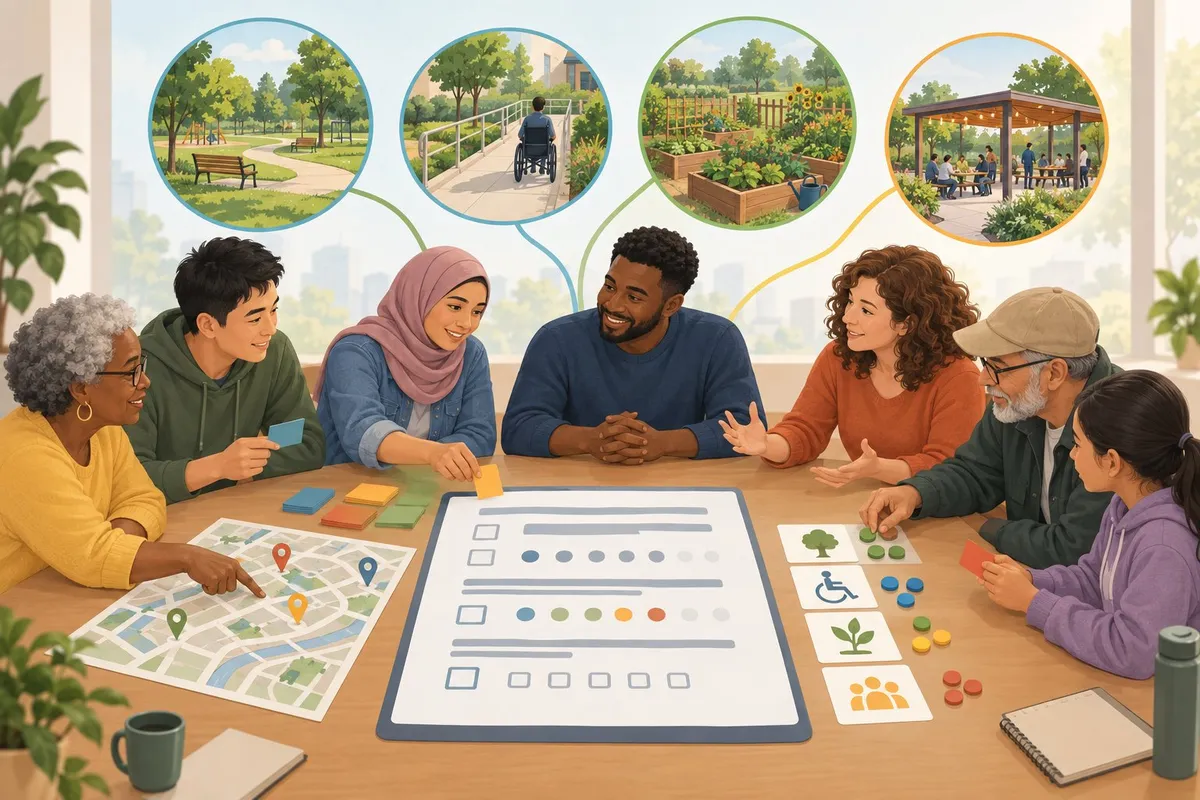
A good survey balances short length with clear question formats, and it reaches people through more than one channel. Once responses come in, the real work starts: reading the data, acting on it, and telling the community what happened next.
Choose Response Formats and Keep the Survey Short
Survey length affects whether people finish the survey or quit halfway through. Survey fatigue sets in fast when a questionnaire drags on with too many open text boxes or repeated questions.
Mixing question types keeps the survey moving and gives you different kinds of data to work with.
| Format | Best for | Watch out for |
|---|---|---|
| Multiple-choice questions | Fast answers, easy comparison | Too few options can box people in |
| Dropdown questions | Long lists like neighborhoods or departments | Slower to answer on mobile |
| Rating scales | Measuring satisfaction or priority | Needs a neutral midpoint |
| Open-ended questions | Capturing detail and new ideas | Takes longer to read and sort |
A survey with 5 to 15 questions works well for quick feedback, while longer community surveys can stretch to 20 questions if the topic calls for it.
Keep demographic information near the end. People answer more honestly once they've already engaged with the main topic.
Reach the Right People Without Relying Only on Online Channels
An online survey alone will miss people who don't use email or social media regularly. Older residents, people without internet access, and non-English speakers often get left out of digital-only outreach.
Mixing channels fixes this gap:
- Paper surveys left at libraries, community centers, or local events
- Phone outreach for residents who prefer talking over typing
- In-person tabling at farmers markets, town halls, or school pickup lines
- Local leaders who share the survey through churches, clubs, or neighborhood groups
- Printed flyers with a QR code and a phone number for those without internet
Community survey templates can be adapted into paper form without much extra work. A community engagement questionnaire works best when it meets people where they already are, not just where it's easiest to send it.
Compare Ratings and Analyze Written Feedback
Quantitative data from rating scales and multiple-choice questions is the easiest place to start. Averages, percentages, and side-by-side comparisons show patterns fast.
Written answers take more effort but often hold the most useful detail. Text analysis means reading through open-ended responses and grouping them by theme, like "parking complaints" or "requests for more lighting."
A simple process works for most community surveys:
- Sort quantitative data first and look for clear majorities or splits.
- Read open-ended responses and tag recurring words or phrases.
- Group tags into three to five main themes.
- Match themes back to the rating data to see if they line up.
- Write a short summary that combines both types of findings.
This process turns scattered answers into a clear picture of what people actually think.
Use Findings to Shape Positioning and Substantive Discussions
Survey results should change what gets discussed next, not just sit in a report. If most residents rate traffic safety as a top concern, that becomes the focus of the next town hall agenda.
Here's how findings connect to action:
| What the data shows | What it means | What to do next |
|---|---|---|
| Low satisfaction with one service | A real problem, not just noise | Schedule a follow-up discussion on that service |
| Split opinions on a proposal | The group isn't aligned yet | Host a forum to talk through the trade-offs |
| High interest in a specific topic | Strong demand for more detail | Build the next survey or meeting around it |
This is where survey research earns its value. It's not about proving a decision was right, it's about finding out what actually matters to the people being served.
Share Decisions and Invite Members to Help Lead
People who take the time to answer a survey want to know what happened with their answers. Skipping this step is one of the fastest ways to lose trust for the next round.
A short recap works well:
- Headline findings: the top two or three things people said
- What changed: a specific decision or action tied to the results
- What's next: another survey, a meeting, or a project timeline
- Thank you: a direct acknowledgment that people took the time to respond
Some community members will want to do more than answer questions. They might offer to help write the next survey, lead a small discussion group, or review draft plans before they go public.
Letting those people take on small, real tasks builds the kind of ownership that keeps a community engaged long after one survey ends.
Frequently asked questions
What are the best questions to ask in a community feedback survey?
The best questions ask about one specific thing and give people an easy way to answer.
| Question type | Example | Why it works |
|---|---|---|
| Rating scale | "How satisfied are you with neighborhood safety, on a scale of 1 to 10?" | Gives a number that can be tracked over time |
| Open-ended | "What is the one change that would improve your experience here?" | Lets people explain in their own words |
| Multiple choice | "Which of these services do you use most often?" | Makes it fast to answer and easy to tally |
| Yes/no with follow-up | "Have you attended a community event this year? If no, why not?" | Finds out who is missing out and why |
Weak version: "Do you like living here?" This question is too broad and gives almost no useful information back.
Strong version: "How would you rate the upkeep of shared spaces like parks and sidewalks?" This version points to one topic and gives a clear answer to act on.
Questions written this way match the kind of detail described in community survey question guides, which recommend keeping each question focused on a single idea.
How can survey questions identify a community’s most pressing needs?
Pressing needs show up when the same complaint or request appears again and again across different people.
Observation → decision → action:
- Observation: Many residents mention slow trash pickup in open-ended answers.
- Decision: Treat this as a top issue, not a one-off complaint.
- Action: Add a follow-up question asking how often pickup is delayed and how it affects daily life.
Questions that help surface these patterns include:
- "What are the top three issues affecting your neighborhood right now?"
- "What new programs or resources would improve things the most?"
- "What is the biggest challenge you face in this part of your life right now?"
These question types appear in neighborhood and public program survey examples, which group similar questions by the kind of feedback they are meant to collect.
A single open-ended question rarely tells the whole story. Pairing it with a rating question on the same topic shows both how big the problem is and how people feel about it.
What questions help measure residents’ satisfaction with local services?
Satisfaction questions work best when they ask about one service at a time instead of lumping them together.
| Service area | Sample question |
|---|---|
| Roads and maintenance | "How satisfied are you with road repair in your area?" |
| Parks and recreation | "How would you rate the condition of local parks?" |
| Safety | "How safe do you feel walking in your neighborhood after dark?" |
| Communication | "How do you prefer to receive updates from local government?" |
Breaking satisfaction into separate, comparable pieces instead of one general "are you happy here" question gives clearer results, an approach described in resident satisfaction survey guidance.
Running the same set of questions on a regular schedule, such as every quarter or year, also makes it possible to see whether satisfaction is improving or getting worse over time.
How can a survey assess whether community members feel heard and included?
Inclusion questions ask about connection and voice, not just service quality.
- "How connected do you feel to other members of this community?"
- "Do you feel your opinions are considered in decisions that affect you?"
- "How valuable are the resources this organization currently provides you?"
- "Would you recommend membership in this community to others?"
These questions match the engagement-focused examples found in membership and workplace community survey resources, which treat belonging as something separate from satisfaction with programs or services.
A low score on feeling heard, paired with a high score on service satisfaction, points to a communication gap rather than a service problem. That distinction changes what action should come next.
What questions can reveal barriers to participating in community activities?
Barrier questions ask why people do not take part, not just whether they do.
- Ask whether the person attended an event or program in a set time period.
- If the answer is no, ask an open-ended follow-up about the reason.
- Offer a short list of common barriers, such as schedule conflicts, lack of childcare, cost, or not knowing about the event.
- Compare answers across different groups, such as age or location, to see if barriers differ.
- Use the results to pick one barrier to address first.
Sample questions:
- "Have you attended a community event this year? If no, why not?"
- "What would make it easier for you to take part in local programs?"
- "How do you typically spend your free time during a normal week?"
Questions about free time and daily responsibilities, drawn from lifestyle and demographic question sets, help explain barriers that are not obvious from attendance numbers alone, as shown in community member profile question examples.
How should a community survey ask residents to prioritize improvements?
Prioritization questions force a choice instead of letting people rate everything as important.
| Format | Example | What it reveals |
|---|---|---|
| Ranking | "Rank these five neighborhood issues from most to least important." | A clear order of priorities |
| Forced choice | "If the city could only fund one project this year, which would you choose?" | The single top priority |
| Budget allocation | "If you had 100 points to divide across these five programs, how would you split them?" | How strongly people feel about each option relative to the others |
| Scale comparison | Rate each improvement on a 1 to 10 scale, then compare averages | A ranked list based on average scores |
A plain satisfaction question will not show what to fix first. A ranking or forced-choice question does, because it makes people compare options directly instead of rating each one alone.
Templates built around this kind of prioritization appear in housing and community feedback question templates, which pair ranking formats with coverage and privacy guidance for handling the results.