
Community Led Growth vs Product Led Growth: Community Gaps

Start here: How to Create a Subreddit for Your Business: Find the Gap
TL;DR
- Product-led growth (PLG) and community-led growth (CLG) are both ways to grow a business without relying only on ads or sales calls, but they work through different paths.
- PLG uses the product itself to bring in new users, while CLG uses a group of engaged people who talk about the product and recommend it to others.
- PLG tends to show results faster, often within six to twelve months, while CLG usually takes twelve to twenty-four months to build real momentum.
- The right choice depends on whether a product can be used and understood on its own, or whether it serves a group of people who already gather to compare notes and share advice.
- Many companies end up using both approaches together, since product use and community activity can support each other over time.

How the Two Growth Engines Differ
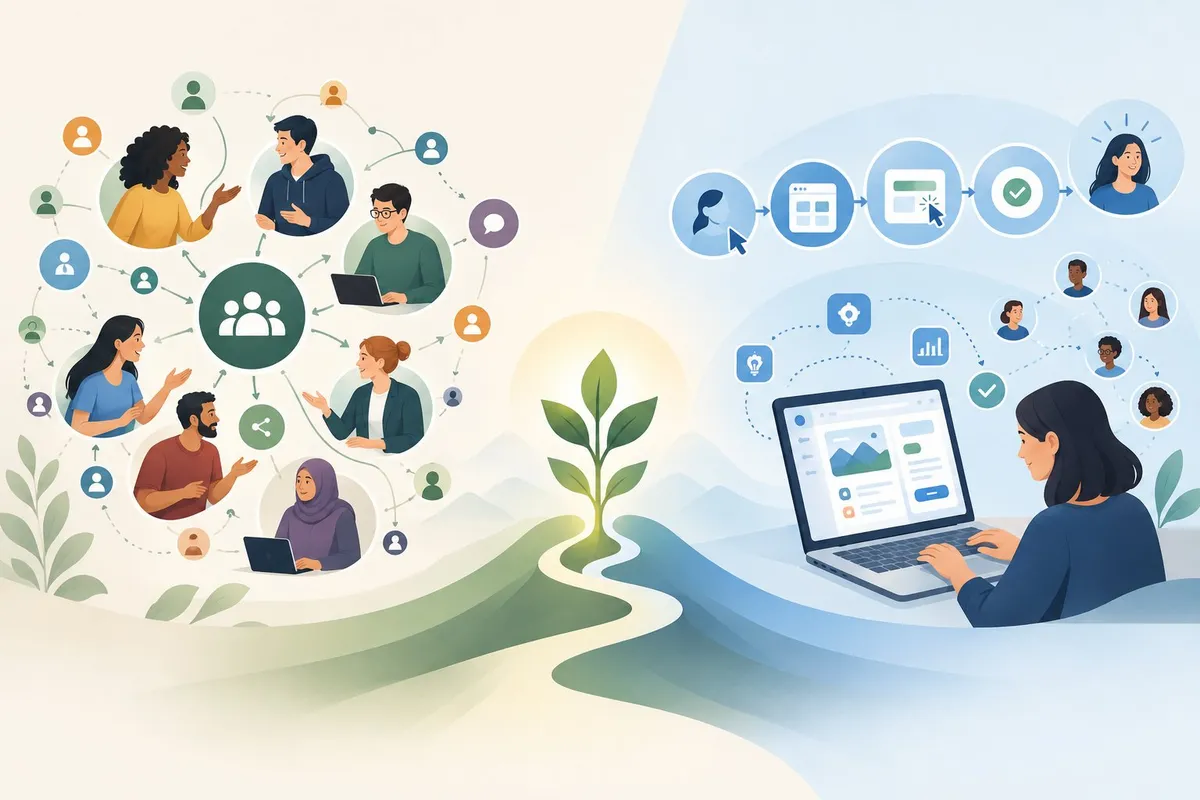
CLG and PLG pull new customers in through different paths and keep them for different reasons. PLG relies on the product experience itself, while CLG relies on relationships between people who already use the product.
The Core Difference: Product Experience or Peer Relationships
PLG treats the product as the main reason someone joins, stays, or upgrades. CLG treats relationships between users as the main reason someone joins, stays, or upgrades.
| Factor | PLG | CLG |
|---|---|---|
| What convinces a new user | The product itself | A peer's recommendation |
| Where trust comes from | Trying the product firsthand | Hearing from someone who already uses it |
| What drives expansion | In-app prompts and feature limits | Community discussion and shared practices |
A self-serve product like a design tool or scheduling app can sell itself through self-serve signups and product experience. A practitioner tool built for a specific trade, such as data engineering, often grows faster through word of mouth inside a identifiable practitioner community. Neither path is better in general. The right choice depends on whether the product can prove its value alone or needs peer context to make sense.
Acquisition Loops: Self-Serve Signups or Community Discovery
PLG acquisition runs through the product. CLG acquisition runs through people talking to each other.
PLG acquisition loop:
- A user signs up without talking to sales
- The user experiences value inside the product
- The user invites teammates or shares a link (such as a meeting invite or document)
- Each invite becomes a new entry point for more signups
CLG acquisition loop:
- A person joins a community space, such as a Slack group or forum, for other practitioners
- The person sees the product mentioned, recommended, or demonstrated by peers
- The person tries the product based on that peer signal
- If satisfied, the person becomes another voice recommending it to others
PLG loops scale with infrastructure and cost little once built. CLG loops take longer to build because they depend on real people having real conversations, which cannot be automated the same way.
Activation and Conversion: Free Trials, Freemium, and Trust
PLG activation happens inside the product. CLG activation happens through trust built by other people.
Want the 3-part comment that gets your brand found on Reddit and Google? Get the free Reddit SEO Blueprint
- Free trials and freemium models let users test the product before paying, which only works if the product reaches time-to-value quickly
- Activation rate measures how many signups reach the moment where the product proves useful to them
- Product Qualified Leads (PQLs) are users who already activated and hit a natural upgrade point, which tends to convert better than leads who have not used the product yet
- Peer trust in CLG often replaces the need for a trial, since a recommendation from a known practitioner carries weight before someone even opens the product
Conversion rates in PLG depend on product design and onboarding. Conversion rates in CLG depend on the strength and credibility of the community doing the recommending.
Retention: Product Habits, Peer Support, and Brand Loyalty
PLG retention comes from habits built inside the product. CLG retention comes from relationships built around the product.
| Retention driver | PLG | CLG |
|---|---|---|
| Main mechanism | Daily or weekly product usage habits | Peer-to-peer support and shared identity |
| What makes leaving costly | Losing workflows and saved data | Losing community standing and relationships |
| Where loyalty forms | Inside the user experience | Inside group discussions and events |
A user who built months of work inside a product is less likely to switch, which is a habit-based retention effect. A user who feels part of a group of practitioners faces a social cost on top of that, since leaving the product can mean leaving the group too. Products that combine both tend to see lower churn among community members than products relying on usage habits alone.
Costs and Measurement: CAC, Engagement, and Lifetime Value
PLG costs show up mainly in engineering. CLG costs show up mainly in people and time.
- Customer acquisition cost (CAC) tends to run lower in PLG because the product replaces work normally done by sales teams
- Community engagement costs more to measure, since community managers, content creators, and event organizers are ongoing expenses that do not shrink as the community grows
- Lifetime value can rise in CLG because of the retention effect tied to peer relationships, though this value is harder to prove with a single number
- Attribution in CLG is harder to track, since a member might read many community posts over months before signing up, which standard CAC models were not built to capture
A company relying on PLG can usually calculate CAC with available product and marketing data. A company relying on CLG needs to track community engagement alongside revenue to see the full picture, since measuring CLG's contribution to revenue requires more patience and more data sources than PLG measurement does.
Choosing and Building the Right Growth Motion
The right growth motion depends on how the product gets used and where the people who care most about it already spend time. A company that gets this match right can build real organic growth instead of paying for every new customer.
When a Self-Serve Product Favors PLG
A product-led motion works best when someone can sign up, get value, and upgrade without ever talking to a salesperson.
| Product trait | PLG fit | Example |
|---|---|---|
| Self-service onboarding | Strong | A user signs up for a free workspace and starts a project in minutes |
| Individual or small-team use case | Strong | Teams share documents without IT approval |
| Clear "aha moment" in the first session | Strong | A user sees a finished design or doc right after signup |
| Heavy enterprise security review required | Weak | Procurement and legal must approve before anyone logs in |
Tools like Slack, Figma, and Notion grew this way. People tried them on their own, found value fast, and brought them into their workplace later. If a product needs a demo, a contract, or enterprise security sign-off before anyone can use it, PLG alone will not carry the growth.
Finding Needs Existing Communities Leave Unmet
A company should look at where its future customers already gather and read what people are struggling to answer.
Signals worth checking:
- Questions asked again and again in forums, subreddits, or Slack groups with no clear answer pinned anywhere
- Threads with many comments but no resolution, showing real demand with no good source of truth
- Outdated pinned resources that no longer match how people actually use the product
- Members who already answer others well, acting as informal experts without being asked
When a company finds a recurring question with no strong answer, that is the gap worth building a community around. This is the starting point of the Right-Crowd Content System, which begins by finding the people who already care before trying to attract more of them.
Naming, Positioning, and Content That Attract Passionate Members
A community name should tell a visitor exactly who it is for and what they will get by joining.
Weak name: "Product Users Group", vague, sounds like a mailing list, gives no reason to click. Strong name: A name that names the specific job or interest, like a group built around a workflow, a role, or a shared problem.
Content that works for this stage:
- Comparisons between tools or approaches
- Project walkthroughs from real users
- Discovery posts where someone shares a new use case
- "What I built" style showcases
This content excites enthusiasts because it gives them something to react to, not just something to read. A content calendar built only around announcements will not do this.
Why Treating Reddit as an Ad Channel Misses the Opportunity
Posting promotional content on Reddit without participating in the community usually gets removed, downvoted, or ignored.
| Approach | What happens | Why |
|---|---|---|
| Drop a product link with no context | Removed by moderators or flagged as spam | Subreddits have rules against unsolicited promotion |
| Answer a real question, then mention the product only if relevant | Often welcomed | It adds value first |
| Disclose a business relationship when posting | Builds trust | Members expect honesty about who is talking |
Reddit threads that buyers actually read carry more long-term value than a single ad impression. A company renting attention in someone else's subreddit should still follow that subreddit's rules and disclose its connection to the product, rather than treating the space like a paid placement.
Building Member-Led Support, Events, and Feedback Loops
Community management works best when it reduces the support burden over time instead of adding more staff work.
Steps to build this:
- Set up a space for questions, whether a Slack community, a forum, or a subreddit.
- Answer questions directly for the first few months to set the tone.
- Highlight members who answer well, giving them visibility and informal status.
- Host community events, like office hours or user meetups, where members can share workflows.
- Collect feedback from discussions and route it to the product team.
- Step back from routine answers as trusted members start answering for the business.
The end result is a group that handles common customer support questions through peer answers, with staff focused on harder cases and product feedback loops. This is the Shift to Member-Led Growth: the company still moderates, but members increasingly carry the daily conversation.
Combining Product Adoption With Community Advocacy
Product adoption and community advocacy reinforce each other when they are built to work together, not as separate tracks.
Observation → Decision → Action:
- Observation: A new user signs up and completes onboarding alone, with no support ticket.
- Decision: This is a sign the product is ready for community-driven growth, not just sales-driven growth.
- Action: Invite that user into the community space where they can share their setup and get tips from others.
Companies like HubSpot and Zoom pair self-service product adoption with active user communities and events, so customer success teams spend less time on repeat questions and more time on larger account needs. User-generated content from these communities, like templates or workflow guides, often answers questions faster than a support ticket would. When product adoption and community advocacy run together, customer relationships get stronger on both sides, and the business sees organic growth in both the product and the group of people recommending it.
Frequently asked questions
How do community-led and product-led growth strategies differ?
Community-led growth uses a group of engaged users to spread a product through shared advice and peer trust. Product-led growth uses the product itself, letting a good user experience convince people to adopt it and tell others.
| Factor | Community-Led Growth | Product-Led Growth |
|---|---|---|
| Main driver | Peer discussion and shared experience | Product usability and value |
| Typical channel | Forums, Slack groups, events | Free trials, freemium plans, in-app prompts |
| Growth speed | Builds gradually through trust | Can scale faster with strong onboarding |
| Best fit | Products with shared learning curves | Products with fast, visible time-to-value |
Community-led growth works best when users benefit from comparing notes with each other, while product-led growth works best when the product explains itself without much outside help.
What are examples of community-led and product-led growth in practice?
Notion is a documented example of community-led growth. The company built shareable templates that users passed to coworkers and friends, and it hired a dedicated head of community early on to support user-led advocacy.
Product-led growth examples usually center on tools that let people start using the product immediately, often through a free tier.
- Project management software that lets a user create a workspace without sales contact
- Design tools that offer a free plan with enough features to produce real work
- File-sharing platforms that grow when one user invites teammates to view a shared folder
In each product-led case, the product itself creates the invitation to new users, rather than a group or forum.
How do community-led, product-led, and sales-led growth compare?
Sales-led growth depends on a sales team actively pursuing and closing deals, which sets it apart from the other two models.
| Strategy | Who drives adoption | Typical cost structure | Decision-maker involved |
|---|---|---|---|
| Community-led | Peer users and advocates | Lower upfront, slower build | Often bottom-up, individual users |
| Product-led | The product experience | Lower cost per user, scalable | Individual users or small teams |
| Sales-led | Sales representatives | Higher cost per deal | Executives or procurement teams |
Sales-led growth tends to suit complex or expensive products that need custom pricing or long-term contracts. Community-led and product-led growth both tend to work better for lower-cost, self-serve products that people can try on their own.
Can a company use community-led and product-led growth together?
Yes, and many growing SaaS and DTC companies combine both to strengthen trust and retention, according to industry coverage of DTC brands that blend community and product strategies.
A company might pair the two approaches like this:
- Launch a product with a clear, fast first-use experience.
- Identify the most active or vocal users inside the product.
- Invite those users into a dedicated community space, such as a forum or Slack channel.
- Let community members share tips, templates, or workflows that extend the product's value.
- Feed common community questions back into product design or onboarding.
- End with a loop where the product attracts users and the community retains them.
This combination works when the product gives people a reason to start, and the community gives them a reason to stay.
How can a company decide which growth strategy fits its product?
The decision depends on how the product is used and whether users benefit from learning from each other.
Observation → Decision → Action
- Observation: Users adopt the product quickly without needing outside help. Decision: Lean toward product-led growth. Action: Invest in onboarding flows and in-app guidance.
- Observation: Users ask similar setup or strategy questions in support tickets. Decision: Lean toward community-led growth. Action: Build a space where users can answer each other's questions.
- Observation: The product requires custom configuration or a long sales cycle. Decision: Lean toward sales-led growth. Action: Build a sales team trained on the product's technical details.
A company can also check whether its product has a "shareable asset," something users naturally pass along, such as a template, report, or workflow. Notion's templates are a documented example of this kind of asset driving community-led adoption.
Which metrics help measure the success of community-led and product-led growth?
Each strategy has its own set of signals, though some overlap.
| Metric Type | Community-Led Growth | Product-Led Growth |
|---|---|---|
| Activity signal | New community members per month | Free trial sign-ups |
| Engagement signal | Comments or posts per active member | Feature adoption rate |
| Retention signal | Returning community members | Monthly active users |
| Lagging indicator | Referral sign-ups from shared links | Conversion from free to paid plan |
For community-led growth, tracking how many people attend events or exchange messages gives an early read on whether the group is gaining strength, since product sign-ups tied to community activity tend to show up later. Product-led growth metrics usually appear faster, since they tie directly to in-app actions like sign-ups, feature use, and upgrades.