
How to Find Customer Pain Points on Reddit: Community Gaps

Start here: How to Get Customers from Reddit: Find Community Gaps
TL;DR
- Reddit pain points show up as recurring complaints, repeated questions, and threads with many replies but no solid answer.
- The fastest way to find customer pain points on Reddit is to search relevant subreddits for recommendation requests, complaint threads, and comparison posts, then group the repeated problems by how often they appear.
- Subreddit search, Reddit's own search bar, and third-party research tools each surface different types of pain point evidence.
- A pain point is only worth acting on once it has appeared across multiple threads or multiple subreddits, not just once.
- The next step after finding a pain point is checking it against other research methods before building anything around it.
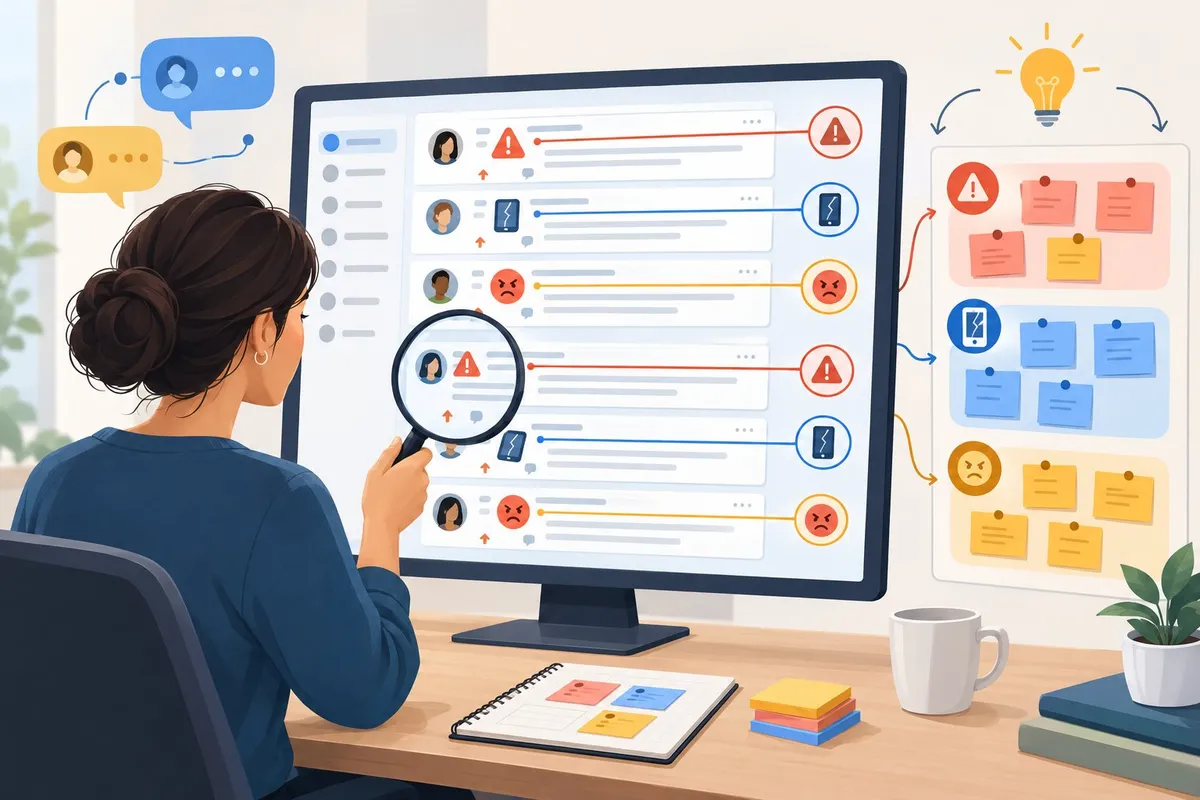
Customer pain points are the frustrations people describe when a product, tool, or service does not work the way they need. Reddit holds a large volume of this kind of feedback because people post about problems in specific communities built around a product, industry, or hobby.
Finding these pain points on Reddit means reading through relevant subreddits and tracking which problems come up again and again. Some people do this manually by searching keywords and scrolling through threads. Others use tools built for this task, such as a step-by-step method for scoring pain points by intensity or a free tool that pulls pain points with quotes and thread links.
This matters for customer research because Reddit conversations are unprompted. People are not answering a survey question, they are describing a real frustration in their own words, which makes the data harder to fake and easier to verify across multiple threads.
Find the Right Discussions and Capture the Evidence
Good pain point research depends on finding the right communities, using the right search terms, and recording evidence in a usable format. These four steps turn scattered Reddit comments into a clear record of unmet needs.
Define the Ideal Customer Profile and Map Relevant Reddit Communities
A clear ideal customer profile comes first. It should name the job, the daily tasks, and the tools that customer already uses.
Once that profile exists, the next task is mapping it to real Reddit communities. A founder building accounting software for freelancers would check subreddits built around freelancing, small business, and specific tools like invoicing apps.
| Customer Trait | Subreddit Type | What to Look For |
|---|---|---|
| Freelance designer | Hobby or trade subreddit | Billing complaints, client disputes |
| Small gym owner | Local business subreddit | Scheduling software requests |
| Remote team manager | Professional trade subreddit | Complaints about current tools |
Each community reveals different parts of the customer's routine, so mapping more than one is normal. This step connects directly to broader pain point discovery work, since the community list becomes the search list for everything that follows.
Search for Complaints, Help Requests, and Alternatives
The fastest way to find pain points is to search for the words people use when something is broken. These searches work better than browsing, because frustration produces predictable language.
Useful search patterns:
- Complaint phrases, "I hate," "so annoying," "worst part of"
- Help requests, "how do I," "is there a way to," "anyone know a tool for"
- Alternative requests, "alternative to," "better than," "switched from"
- Comparison threads, "X vs Y," "which is better"
- Deal or discovery posts, "found this," "just started using"
Each pattern points to a different kind of signal. Complaint phrases show pain. Help requests show missing solutions. Alternative requests show dissatisfaction with existing solutions. Running these searches inside the mapped subreddits, rather than across all of Reddit, keeps the results tied to the right audience, a method covered in detail in this Reddit pain-point research guide.
Read Comments for Workarounds and Unmet Needs
The original post is only half the story. The comment section usually holds the more useful detail.
Observation: A thread has 40 comments but no single reply solves the problem. Decision: This is a strong signal of an unmet need. Action: Save the thread and note how many people agreed without a real fix.
Observation: Several commenters describe a manual workaround, like a spreadsheet or a browser extension. Decision: This shows real demand, since people built their own fix. Action: Record the workaround and the tools it replaces.
Workarounds are one of the clearest forms of customer feedback, because they show what a person was willing to do before a product existed. A workaround that keeps reappearing across threads is rarely a one-off complaint.
Record Exact Quotes, Context, and Thread Links
Evidence only holds up if it can be checked later. Paraphrasing a complaint weakens it, and loses the original voice of customer.
A simple record for each finding should include:
- Exact quote, copied word for word, not summarized
- Subreddit and thread link, so the original context can be reviewed
- Date posted, pain points tied to outdated tools lose relevance over time
- Comment count or upvotes, a rough signal of how many people share the view
- Workaround or tool mentioned, if one was named
This record becomes the foundation of real pain point research, and it should stay organized by community and topic so patterns are easy to spot later. Keeping links attached to every quote also protects the research from losing credibility, since anyone on the team can trace a claim back to its original thread, a practice outlined in this guide to preserving source context.
Evaluate Community Gaps Before Building a Solution

A pattern in a Reddit thread is not proof that people will buy something. Before any product gets built, the pattern needs grouping, comparison against what already exists, and a check on whether people will actually pay for a fix.
Group Recurring Problems Without Mistaking Upvotes for Demand
A high upvote count means a comment connected with readers. It does not mean people will pay to solve the problem it describes.
| Signal | What it usually means | What to check next |
|---|---|---|
| High upvotes, short comment | The complaint is relatable | Search for the same complaint in other threads |
| Long comment thread, mixed opinions | The topic is debated, not settled | Look for a shared root cause across replies |
| Same question posted monthly | A real, recurring problem exists | Note how people currently work around it |
| Low upvotes, detailed complaint | A niche but specific pain point | Check if the niche is large enough to matter |
Group complaints by the underlying problem, not by wording. Three different phrasings of "I can't find a tool that does X" belong in the same bucket. This kind of clustering is standard Reddit pain-point research practice, and it turns scattered venting into a shortlist of problems worth testing.
Compare Existing Solutions and Identify Who Remains Underserved
Before assuming a gap is open, check what already exists. Many "unsolved" problems already have three or four tools competing for the same users.
Observation: A thread complains about a tool, but ten replies name a competitor that already fixes it. Decision: Treat this as a weak opportunity. Action: Move to the next cluster instead of building a competing tool from scratch.
Observation: A thread complains about a tool, and replies suggest spreadsheets, manual workarounds, or "nothing good exists yet." Decision: Treat this as a stronger opportunity. Action: Note who is underserved, beginners, a specific industry, or a specific budget tier.
Market research done this way separates a crowded category from a genuine gap. A segment ignored by every existing tool is worth more than a popular complaint about a tool that already has five competitors.
Use Research Tools to Surface Patterns, Then Verify the Source Threads
Research tools speed up pattern-finding, but every pattern still needs a human check against the original thread.
- GummySearch groups subreddit activity by theme and can surface recurring complaint topics across many communities at once.
- PainOnSocial applies AI-powered pain point extraction to Reddit discussions and generates solution ideas based on the clusters it finds, as described on its own Reddit pain point overview.
- DemandProofHQ scans public threads, clusters repeated complaints, and scores each one for demand strength, a process it explains on its pain point scoring page.
- Sentiment analysis tools can flag frustration versus casual mention, but they can misread sarcasm or niche slang.
AI-powered analysis is a starting filter, not a final answer. Every flagged thread needs a manual read to confirm the complaint is real and recent.
Test Willingness to Pay Through Interviews and Landing Pages
A pain point without willingness to pay is not a business opportunity. Two cheap tests confirm whether people will act, not just complain.
- Find five to ten people from the Reddit threads who described the same problem in detail.
- Run customer interviews asking what they currently pay for workarounds, if anything.
- Build a simple landing page describing the solution and a price.
- Run landing page tests by sharing the link in relevant threads or communities, where allowed by each subreddit's rules.
- Count actual sign-ups or pre-orders, not just clicks or comments.
A reader finishes this step with a short list of validated business opportunities, backed by real commitments instead of upvotes.
Use the Findings to Guide Product Strategy and Community Participation
Validated pain points should shape product strategy directly: what gets built first, what gets skipped, and which underserved segment gets the first version.
Product development should start with the complaint that showed both a clear gap and confirmed willingness to pay, not the one with the most upvotes. The same research also shows which subreddits hold the most relevant future customers. Participating there honestly, without disguised promotion, builds standing in that corner over time rather than renting attention for a single post.
Frequently asked questions
Which subreddits are most useful for identifying customer pain points?
The most useful subreddits are the ones where a founder's actual buyers already ask questions and compare options.
| Subreddit type | Good for | Watch out for |
|---|---|---|
| Trade or professional subreddit (example: r/sysadmin, r/accounting) | Finding detailed, technical frustrations from people who use tools daily | Jargon-heavy threads that need context to interpret correctly |
| Buyer-advice subreddit (example: r/BuyItForLife, r/SaaS) | Spotting comparison threads and "what should I use instead" posts | General venting that isn't tied to a specific product gap |
| Hobby subreddit (example: r/running, r/gardening) | Seeing recurring complaints about gear, apps, or services tied to the hobby | Niche language that doesn't translate to a broader market |
| Local or city subreddit | Service-based pain points, like contractors or delivery issues | Problems too localized to signal a scalable business opportunity |
A founder should check the subreddit's sidebar and rules before posting or quoting discussions, since some trade and professional communities restrict self-promotion or external research.
How can I search Reddit for recurring customer complaints?
Searching Reddit for recurring complaints means using targeted phrases, not broad keywords.
- Open Reddit's search bar and enter a product category plus a frustration word, such as "invoicing software annoying."
- Use Reddit's built-in filters to sort by "Top" and set the time range to "Past Year" to catch patterns, not one-off rants.
- Search Google with
site:reddit.complus the product name and words like "hate," "wish," or "alternative." - Open threads with high comment counts but no clearly upvoted solution, this signals an unresolved problem.
- Save the exact phrases people use to describe the frustration, since this becomes useful language for product messaging later.
- Repeat the search monthly to see if the same complaints keep resurfacing.
At the end of this process, a founder has a running list of complaint threads sorted by how often the same issue appears.
How can SaaS founders find product pain points in Reddit discussions?
SaaS founders find pain points by watching for threads where many people ask the same question and no one offers a solid answer.
- Comparison threads: Posts asking "X vs Y, which is better" reveal what features people weigh against each other.
- Migration threads: Posts asking "how do I switch from X" show what's pushing people away from a competitor.
- Workaround threads: Posts describing a manual fix for something software should handle automatically.
- Outdated resource complaints: Comments pointing out that a subreddit's pinned guide or wiki is stale or wrong.
- Repeat questions: The same question appearing every few weeks, even if past answers exist.
One Reddit thread in r/SaaS specifically discusses how founders discover customer pain points and unmet needs by asking other builders directly, which confirms that founders already treat Reddit as a primary research channel rather than a side source.
What are examples of customer pain points people share on Reddit?
Pain points on Reddit usually show up as specific, detailed complaints rather than vague frustration.
| Pain point type | What it looks like on Reddit | Why it matters |
|---|---|---|
| Missing feature | "I wish [tool] could export to CSV automatically" | Shows a gap competitors haven't filled |
| Pricing frustration | "Why does this cost $50/month for one extra seat" | Signals a pricing model mismatch |
| Poor support experience | "Support took 3 weeks to respond to a bug report" | Points to a service-quality opportunity |
| Workflow friction | "I have to copy data between two apps every day" | Reveals integration or automation demand |
These examples work best when a founder collects several from the same subreddit, since one complaint could be an outlier but five similar ones suggest a pattern.
How can I tell whether a Reddit complaint reflects a widespread problem?
A single complaint is just one data point; a widespread problem shows up across multiple threads, subreddits, and time periods.
Observation: The same complaint appears in three or more separate threads over several months. Decision: Treat it as a validated pain point worth further research. Action: Cross-check the complaint on a second subreddit or platform, like a competitor's support forum, to confirm it isn't limited to one community's bias.
Observation: A complaint thread has many upvotes but very few comments. Decision: Be cautious, since high upvotes with low discussion can mean people agree without elaborating, not that the problem is urgent. Action: Look for comments that add specific detail, not just agreement, before counting it as strong evidence.
Observation: A complaint only appears once and gets no upvotes or replies. Decision: Treat it as low-priority until more evidence appears. Action: Note it and revisit the search in a month to see if it resurfaces.
This step matters because it separates a real, widespread need from a single frustrated person venting about a bad day, some guides describe testing methods that go further, including separating real pain points from ordinary venting using specific checks.
What free tools can help me track customer pain points on Reddit?
Several free tools scan Reddit automatically and surface complaints without requiring manual searching.
- PainBase scans specific subreddits or niches and surfaces what people are complaining about as raw material for a startup idea.
- OpinionDeck searches Reddit for unfiltered frustrations and positions itself as an AI-powered alternative to biased surveys or costly interviews.
- Reddinbox pulls pain points from both Reddit and Hacker News, returning frequency counts, exact quotes, and thread links for free.
- Reddily uses AI to identify and rank customer frustrations with supporting evidence pulled from Reddit discussions.
A founder using these tools should still read the original threads before acting, since automated ranking can miss context that only shows up in the full conversation.